
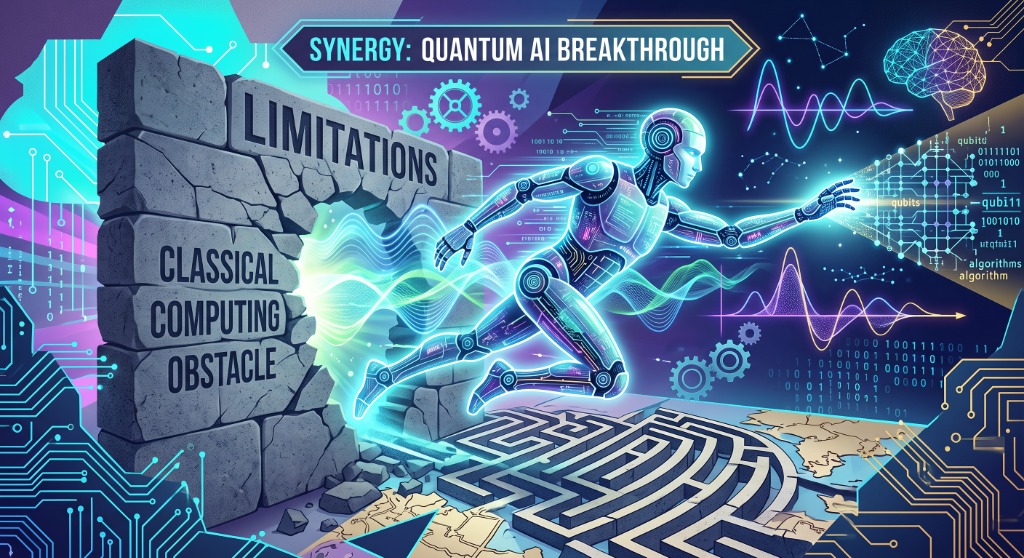
1. Introduction: The Need for a Paradigm Shift
Researchers, engineers, and data architects working on advanced AI frequently encounter the limitations of classical computing. Training complex neural architectures on extensive datasets using large GPU clusters can encounter significant bottlenecks when optimization processes stall. When the loss function flattens, algorithms become trapped in local minima or barren plateaus, stalling further progress.
Classical optimization methods, such as stochastic gradient descent (SGD) and Adam, navigate loss landscapes iteratively based on local gradient information. When encountering a shallow local minimum, these algorithms can struggle to make progress toward the global optimum. Overcoming these barriers via classical computation requires substantial processing power and energy, driving up operational costs and delaying development.
An alternative approach emerges at the intersection of quantum physics and machine learning: quantum tunneling. While classical algorithms must traverse energy barriers in the optimization landscape, quantum approaches can pass through narrow barriers directly. Adopting these quantum-assisted optimization techniques offers a viable path beyond classical computational limitations. This essay examines the physics behind quantum tunneling, its applications in deep learning, hardware implications, and its relevance to cognitive modeling.
2. The Physics of Quantum Tunneling
Understanding quantum optimization requires examining how quantum systems behave differently from classical ones. In macroscopic classical mechanics, an object with insufficient kinetic energy cannot cross a potential energy barrier. In optimization, this corresponds to an algorithm becoming permanently trapped in a local minimum when it lacks the energy to climb the surrounding landscape.
In quantum mechanics, microscopic particles are described by a wave function $\psi(x, t)$ governed by the Schrödinger equation:
When a wave function encounters a potential barrier $V(x) > E$, its amplitude decays exponentially within the barrier rather than dropping instantly to zero. If the barrier is sufficiently thin, a non-zero probability amplitude remains on the other side, allowing the particle to traverse the barrier.
Using the Wentzel-Kramers-Brillouin (WKB) approximation, the transmission probability $T$ across an arbitrary potential barrier $V(x)$ bounded by classical turning points $x_1$ and $x_2$ is formulated as:
This fundamental equation highlights critical operational divergences between classical and quantum optimization:
- Thermal vs. Quantum Transitions: Classical methods like Simulated Annealing rely on thermal transitions over barriers (Arrhenius law), where success probability decreases exponentially with barrier height $\Delta V$: $P \propto e^{-\Delta V / k_B T}$.
- Height vs. Width Dependency: High energetic barriers severely inhibit classical convergence. In contrast, quantum tunneling probability depends primarily on barrier width $(x_2 - x_1)$ rather than sheer barrier height.
- Penetrating Narrow Walls: When encountering high but narrow potential barriers, quantum optimizers pass through them directly to reach lower-energy states efficiently.
3. Barren Plateaus and High-Dimensional Loss Landscapes
Modern neural networks operate in parameter spaces spanning millions to hundreds of billions of dimensions. These optimization landscapes feature distinct structural challenges:
- Saddle Points: The classical loss landscape is saturated with high-index saddle points—regions where the gradient is zero because the function increases in some directions and decreases in others.
- Classical Stagnation: Stochastic gradient descent stagnates in these flat neighborhoods, expending immense compute cycles to identify escaping descent eigenvectors.
- Barren Plateaus in QML: In Parameterized Quantum Circuits (PQC), this manifests as barren plateaus, where the gradient variance vanishes exponentially with qubit count $n$:
$$\text{Var}_{\theta}\left[\frac{\partial \langle H \rangle}{\partial \theta_k}\right] \in \mathcal{O}\left(\frac{1}{2^n}\right)$$
- Concentration of Measure: Random PQCs of sufficient circuit depth form approximate unitary 2-designs, smearing quantum state information uniformly across the vast $2^n$-dimensional Hilbert space and rendering gradient estimates indistinguishable from white noise.
- Quantum Convolutional Neural Networks (QCNN): Utilize dissipative quantum pooling layers to systematically reduce entanglement and qubit width, provably preventing barren plateaus.
- Tensor Network Warm-Starts: Employ classical Matrix Product States (MPS) or PEPS to initialize circuit parameters into a convex attraction basin.
- Local Cost Functions: Replacing global Hamiltonians $H = \sum Z_i$ with local observables $H = Z_j \otimes Z_{j+1}$ ensures polynomial gradient scaling $\mathcal{O}(1/\text{poly}(n))$.
4. Quantum Hamiltonian Descent (QHD)
Quantum Hamiltonian Descent (QHD) formulates continuous non-convex optimization as a physical quantum dynamical system. Rather than tracking a discrete, memoryless classical trajectory, QHD models optimization through wave function dynamics governed by the time-dependent Schrödinger equation using path integral formulations.
The continuous dynamical system is steered by the time-dependent Hamiltonian $\hat{H}(t)$:
Key architectural components of this Hamiltonian include:
- Target Potential Energy: The term $e^{\chi t}f(x)$ encodes the objective loss function we seek to minimize, scaled by adiabatic scheduling parameter $\chi$.
- Kinetic Delocalization Operator: The kinetic energy incorporates the Laplace operator $-\frac{1}{2}\Delta$, inducing continuous spatial delocalization of the wave packet across the entire search volume.
As the scheduling parameters $\varphi$ and $\chi$ evolve, kinetic delocalization gradually attenuates, forcing the probability density $|\psi(x, t)|^2$ to collapse and concentrate directly inside the global minimum. When coupled with Augmented Lagrangian frameworks (AL-QHD), this provides mathematically provable convergence for constrained industrial combinatorial challenges.
5. Quantum Annealing vs. Classical Simulation
At the physical hardware layer, Quantum Annealing (QA) processors (such as superconducting flux-qubit QPUs) provide commercial-scale realization of tunneling optimization. QA specializes in solving Quadratic Unconstrained Binary Optimization (QUBO) problems mapped onto the Ising spin Hamiltonian:
| Feature | Classical Simulated Annealing (SA) | Quantum Annealing (QA) | Quantum Hamiltonian Descent (QHD) |
|---|---|---|---|
| Traversal Mechanism | Thermal excitation over barrier peaks | Transverse-field quantum tunneling | Continuous wave packet delocalization |
| Barrier Sensitivity | Exponential in barrier height $\Delta V$ | Polynomial in barrier width $w$ | Governed by kinetic Laplace operator |
| Target Problem Space | Discrete & Continuous | Discrete Ising / QUBO graphs | Continuous & Constrained Non-Convex |
| Noise Sensitivity | Thermal noise is utilized as driver | Requires mK cryogenic shielding | Requires coherent unitary or error-mitigated gate depth |
6. Hardware Considerations: Quantum Tunneling-Aware Machine Learning (QTAML)
At nanoscale semiconductor dimensions, quantum tunneling shifts from an algorithmic asset to a physical engineering challenge. As silicon transistor gate dielectrics approach sub-3nm scales, electron leakage through gate oxides creates parasitic static power dissipation and stochastic bit-flip errors.
Quantum Tunneling-Aware Machine Learning (QTAML) inverts this constraint by modeling hardware-level tunneling noise directly within neural network loss functions. Through Tunneling-Aware Compensation (TAC) algorithms, weights are trained to be intrinsically resilient to quantum drift, permitting microcontrollers and edge neuromorphic chips to operate at ultra-low supply voltages ($V_{dd} \ll 0.5\text{V}$) with minimal energy consumption.
7. Quantum Models in Cognitive Science & QT-DNN
Beyond physical computation, quantum probabilistic frameworks offer mathematical tools for modeling human decision-making that violates classical Bayesian probability.
Phenomena such as the conjunction fallacy (where human evaluators rate $P(A \land B) > P(A)$) violate Kolmogorov's classical probability axioms. Quantum cognition models represent mental states as vectors in Hilbert space:
In machine learning architectures, Quantum Tunneling Deep Neural Networks (QT-DNN) incorporate quantum-inspired activation functions. These activations permit latent feature representations to evaluate parallel trajectories across complex decision surfaces, boosting training convergence on noisy multi-modal datasets.
8. Dequantization and Evaluating Quantum Speedups
Evaluating claims of quantum advantage requires rigorous comparison with classical algorithms. Research into "dequantization" demonstrates that certain quantum algorithms can inspire classical algorithms with comparable polynomial complexity.
- Tang’s Recommendation Theorem: Ewin Tang proved that recommendation system algorithms once thought to possess exponential quantum speedups could be dequantized into classical randomized linear algebra algorithms operating in polynomial time, given Sample and Query (SQ) Oracle access.
- Matrix Transformations: Principal Component Analysis (PCA), k-means clustering, and low-rank matrix Support Vector Machines have similarly undergone rigorous dequantization.
- Boundary of Advantage: When input data is classical, sparse, and low-rank, classical randomized SVD frequently matches quantum asymptotic scaling. Provable quantum advantage requires either quantum-native state inputs, high circuit entangling depth, or non-abelian topological structures.
9. Quantum-Inspired Optimization and Hybrid Systems
Near-term industrial deployments increasingly rely on hybrid quantum-classical architectures that combine existing high-performance computing clusters with specialized quantum co-processors:
- Quantum-Inspired Optimization (QIO): Digital annealers and simulated bifurcation machines implemented on FPGAs simulate tunneling dynamics to solve combinatorial vehicle routing, bin packing, and job shop scheduling problems.
- Variational Quantum Eigensolver (VQE) & QAOA: In our Classiq-powered DispatchEngine architecture, 32-qubit QAOA variational circuits explore subtour permutation spaces while classical COBYLA optimizers iterate parameters, dividing workloads to accelerate end-to-end schedule synthesis.
10. Energy Efficiency and Operational Impact
The expansion of hyperscale AI model training is colliding with severe electrical grid and thermodynamic limits. Classical silicon computation is bounded by Landauer's principle, dissipating at least $k_B T \ln 2$ Joules of heat for every bit of irreversible information erased.
Because quantum state evolutions are governed by unitary operators $U^\dagger U = \mathbb{I}$, intermediate quantum calculations are fundamentally reversible and theoretically dissipate zero thermodynamic heat during gate execution. Cryogenic cooling power budgets for QPUs remain essentially flat as algorithm complexity scales, unlike mega-watt GPU clusters whose power dissipation scales linearly with compute volume.
11. Workforce Development and Ethical Governance
The convergence of quantum computing and artificial intelligence necessitates an interdisciplinary engineering workforce capable of bridging quantum information theory, deep learning systems, and hardware synthesis.
Simultaneously, quantum-enhanced AI systems require forward-looking governance models:
- Post-Quantum Cryptography (PQC): Securing autonomous dispatch and WMS communications against future Shor-algorithm decryption via NIST-standardized lattice cryptography (FIPS 203/204).
- Algorithmic Transparency: Guaranteeing that quantum variational heuristic decisions remain certifiable and explainable under industrial safety mandates such as DIN EN ISO 3691-4.
12. Conclusion
As traditional silicon semiconductor scaling reaches atomic boundaries and loss surfaces grow increasingly complex, pure scaling of classical gradient optimization faces diminishing returns.
Quantum tunneling provides a rigorous mathematical and physical mechanism for traversing energy barriers, mitigating barren plateaus, and escaping local optima that halt classical algorithms. By integrating quantum Hamiltonian descent, variational ansatz circuits, and quantum-inspired digital annealing into hybrid WMS digital twin pipelines, organizations can build scalable, thermodynamically efficient, and resilient computational architectures.